A tiny world, ready to explore
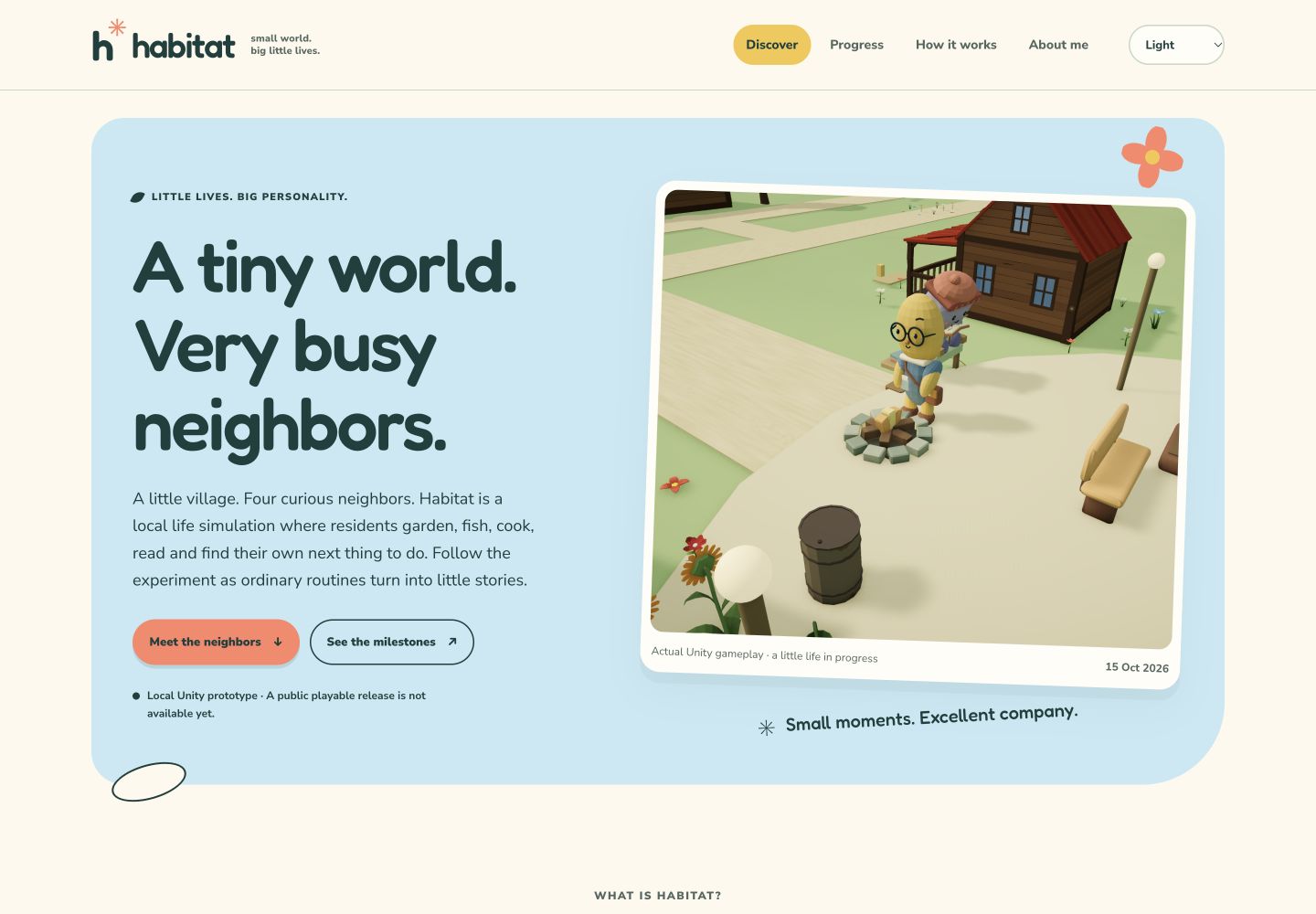
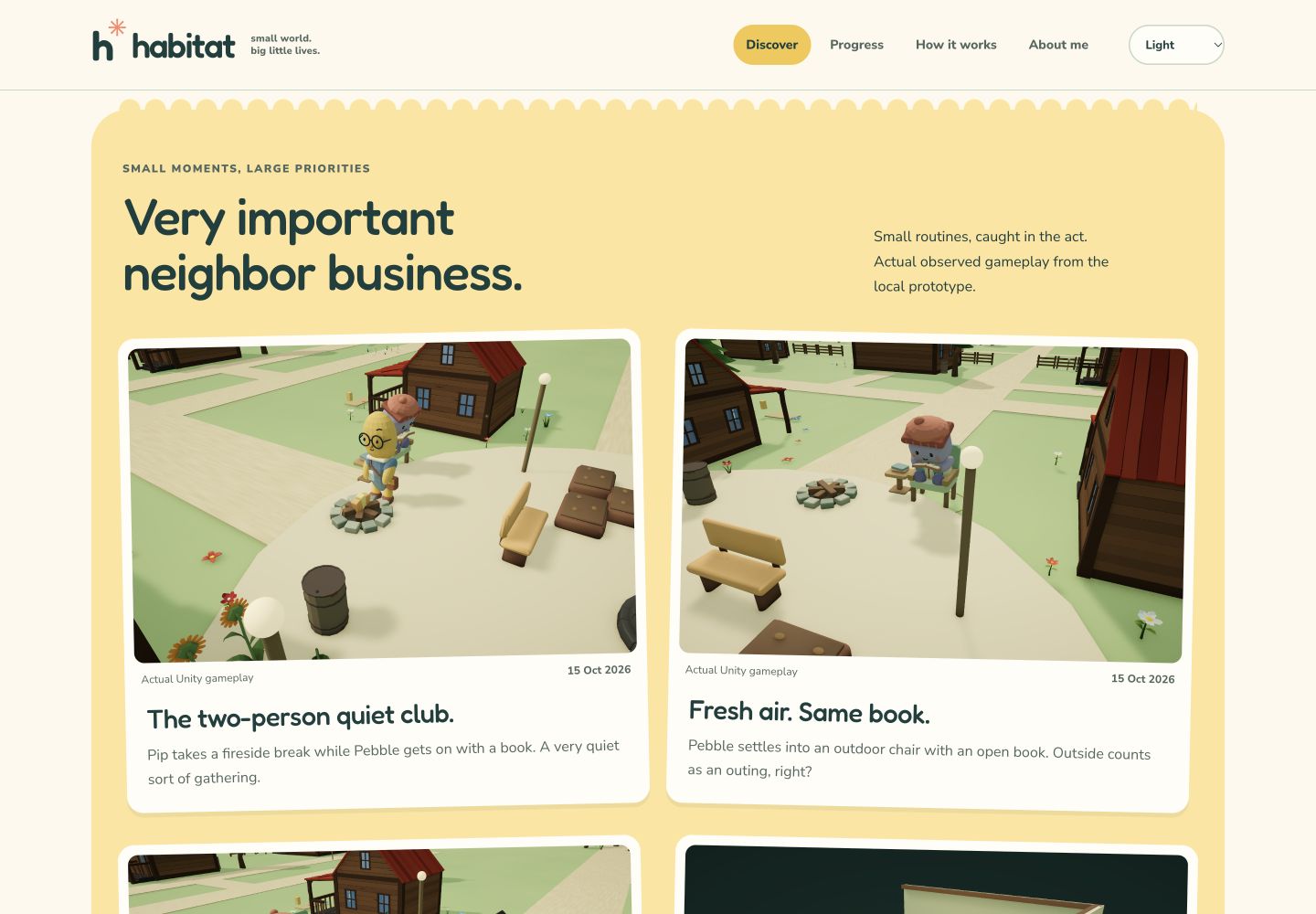
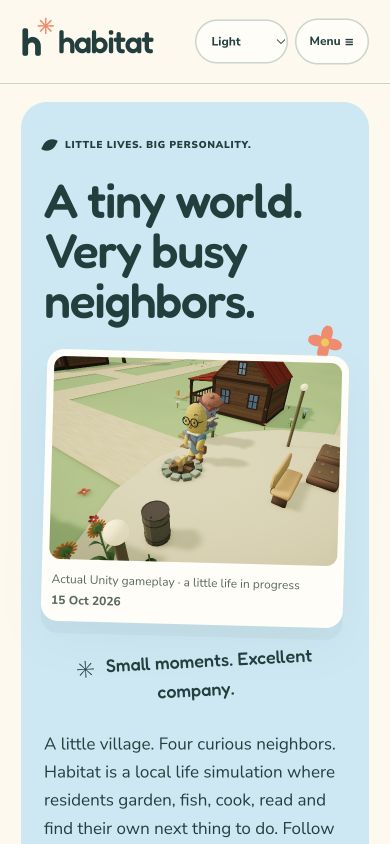
The colorful welcome now puts ordinary village life first: a fireside break, books, a bench, four neighbors and five completed milestones. The same story works across all four pages and in the static reading edition.
Full entry & measurements
How can a website feel as welcoming as the little world it introduces? The new Discover page leads with genuine gameplay, explains everyday activities and clearly identifies Habitat as an early prototype without a public playable release. Four newly selected photographs show unforced native Unity routines; original studio portraits remain explicitly labeled. Sky, cream, coral, mint and lilac, local Fredoka/Nunito Sans fonts, postcard frames and generous controls carry through Progress, How it works and About in light and dark themes. Five completed milestones appear on Discover; planned roadmap goals remain in the detailed project archive. Actual website captures in playful-web-20261015/04-final document the final rendered iteration, frozen as playful-site-4a222aed5faa4112. Its app SHA-256 is 83cecffe54e7e4967df325a7b594353bd2f146ffbec7536d62a67bccdbc75668, CSS 9414c5348b4f93f784702d707adcdafbfb8aa77c5883a83ed3d11739699fe6e2 and progress db1dc68bc12932e8f2c420b260838cf1057ba7e42af62d31a1a8df7041318a8a. Measurements on 15 October 2026 UTC: 117 scoped Python tests passed in 18.84 seconds (static pages, public boundary, overview serving, export, evidence and fonts); 24/24 isolated journal-renderer checks passed; 32/32 browser route/width/theme views passed; 8/8 script-omitted static HTML route/width views passed. The later public-site recheck passed 22 overlapping tests, not an additional independent total. Browser widths were 320, 390, 768 and 1440 CSS pixels, with both themes and a 1000-pixel viewport height. No horizontal overflow, broken viewport images, autoplay or sub-44-pixel visible application targets were found in the final matrix; local fonts loaded. Image provenance dialogs, Escape focus restoration, menu navigation, anchors, appearance persistence, filters and deliberate video play/pause/seek were exercised. Native dialog focus could visit browser chrome but did not reach background application controls. No console/CSP diagnostics were returned. The browser surface exposes neither exact engine version nor JavaScript/reduced-motion preference toggles: static views use a copy with script elements removed, and reduced-motion behavior was checked in CSS source. These are desktop browser viewport checks, not physical-device tests. The final enlarged portfolio link and all earlier visual iterations are preserved, including weaker initial framing. Full reports and source identities remain in private verification records. The generated website repository and upload ZIP carry only the reviewed publication selection; live Plesk deployment remains with the owner. Next: inspect the deployed edition on physical phones and continue observing naturally occurring routines.